
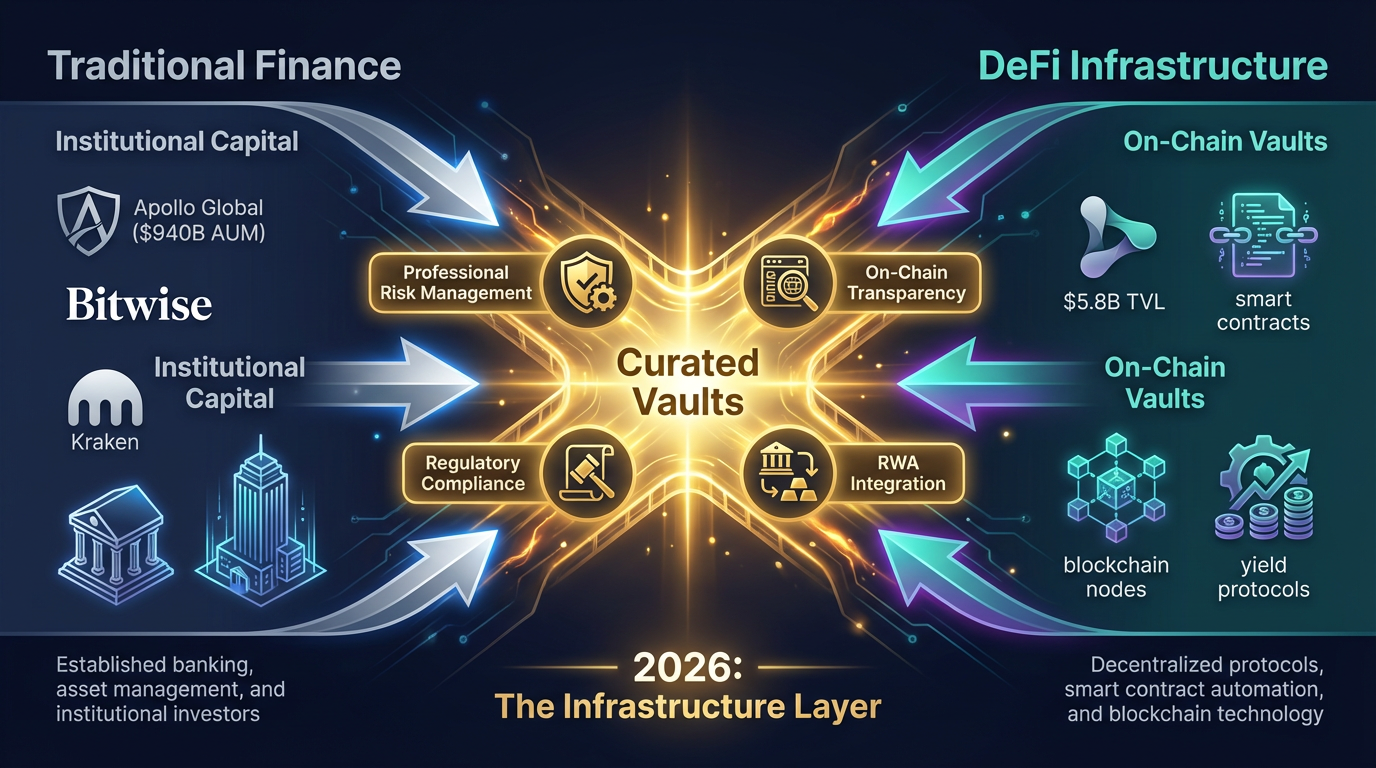
In January 2026, Kraken launched DeFi Earn, a product that routes centralized exchange deposits into on-chain lending vaults managed by professional risk teams. Within weeks, tens of millions of dollars flowed in. Around the same time, Apollo Global Management, a firm managing $940 billion in traditional assets, signed a deal to acquire up to 9% of Morpho’s token supply over four years. These aren’t speculative bets on meme tokens. They’re calculated moves into DeFi vaults, the infrastructure layer that quietly became the dominant way to earn yield on-chain.
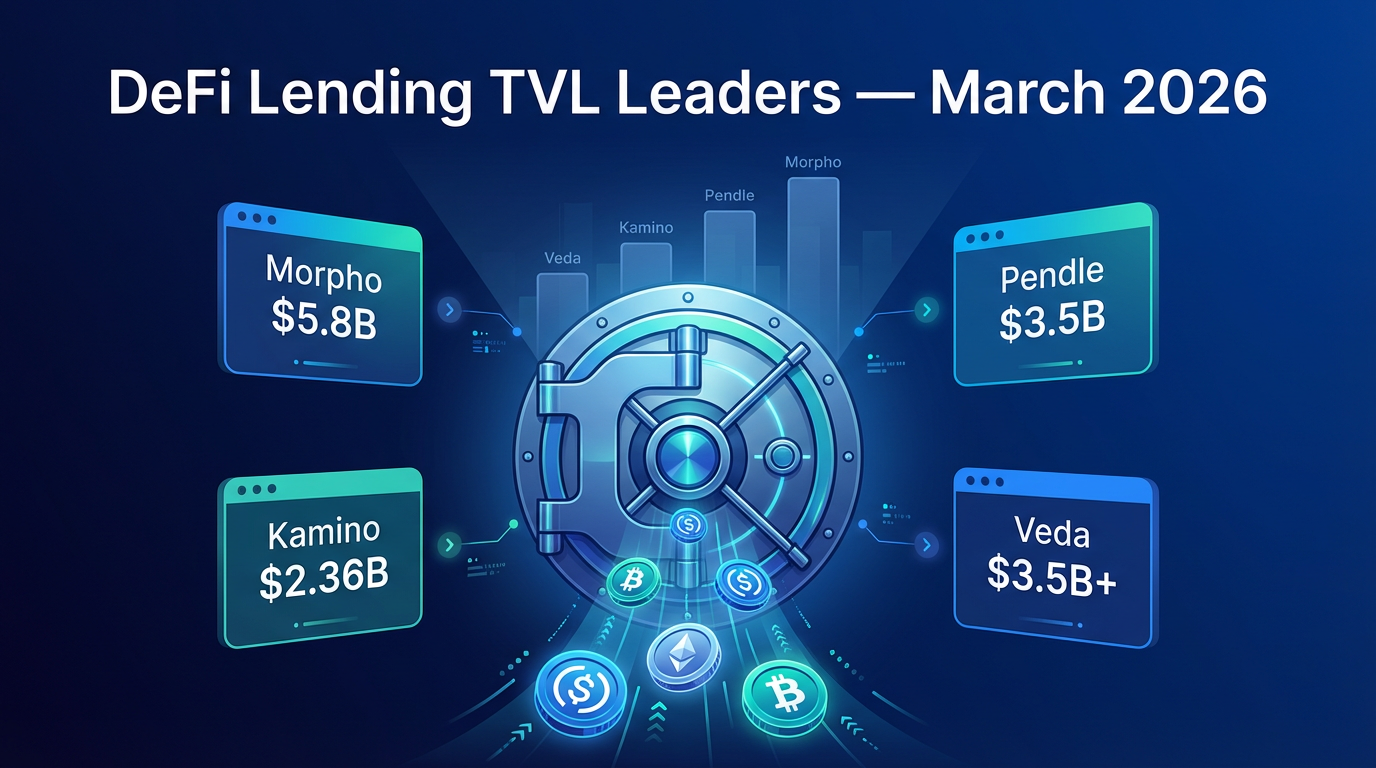
The numbers tell the story. Morpho’s curated vault system holds roughly $5.8 billion in total value locked. Kamino manages $2.36 billion on Solana. Pendle’s yield tokenization protocol sits at $3.5 billion across 11 chains. The classic yield aggregator category (Yearn, Beefy, and others) totals around $1.6 billion combined. Capital has spoken.
This guide breaks down exactly how DeFi vaults work, why curated vaults overtook their predecessors, and how you can use them in 2026, whether you’re a retail user parking stablecoins or an institution deploying eight figures.
What Are DeFi Vaults?
A DeFi vault is a smart contract that accepts your crypto deposits and puts them to work earning yield. You can think of it like a managed savings account, except it runs on code rather than a bank’s back office, and every transaction is visible on a public blockchain.
Here’s the basic flow. You deposit an asset, say USDC, into a vault. The vault issues you shares (often following the ERC-4626 standard, a widely adopted token specification for yield-bearing vaults). Those shares represent your proportional claim on the vault’s total assets. While you hold them, the vault’s strategy generates yield, through lending, providing liquidity, staking, or some combination of all three. Rewards are harvested and reinvested automatically. When you want out, you redeem your shares for the underlying asset plus any accumulated gains.
The ERC-4626 standard matters because it made vaults composable. Before it existed, every protocol had its own custom vault interface. ERC-4626 standardized how deposits, withdrawals, and share accounting work. Now a Morpho vault, a Yearn vault, and a Pendle principal token can all plug into the same DeFi infrastructure without custom integration code.
Vaults solve a real problem for most users. Raw yield farming requires constant monitoring: you need to check rates across protocols, manually harvest rewards, rebalance between positions, pay gas on every transaction, and stay aware of liquidation thresholds. Vaults automate all of that. You deposit once. The vault handles the rest.
Evolution of Vaults: From Yearn to Curated Powerhouses
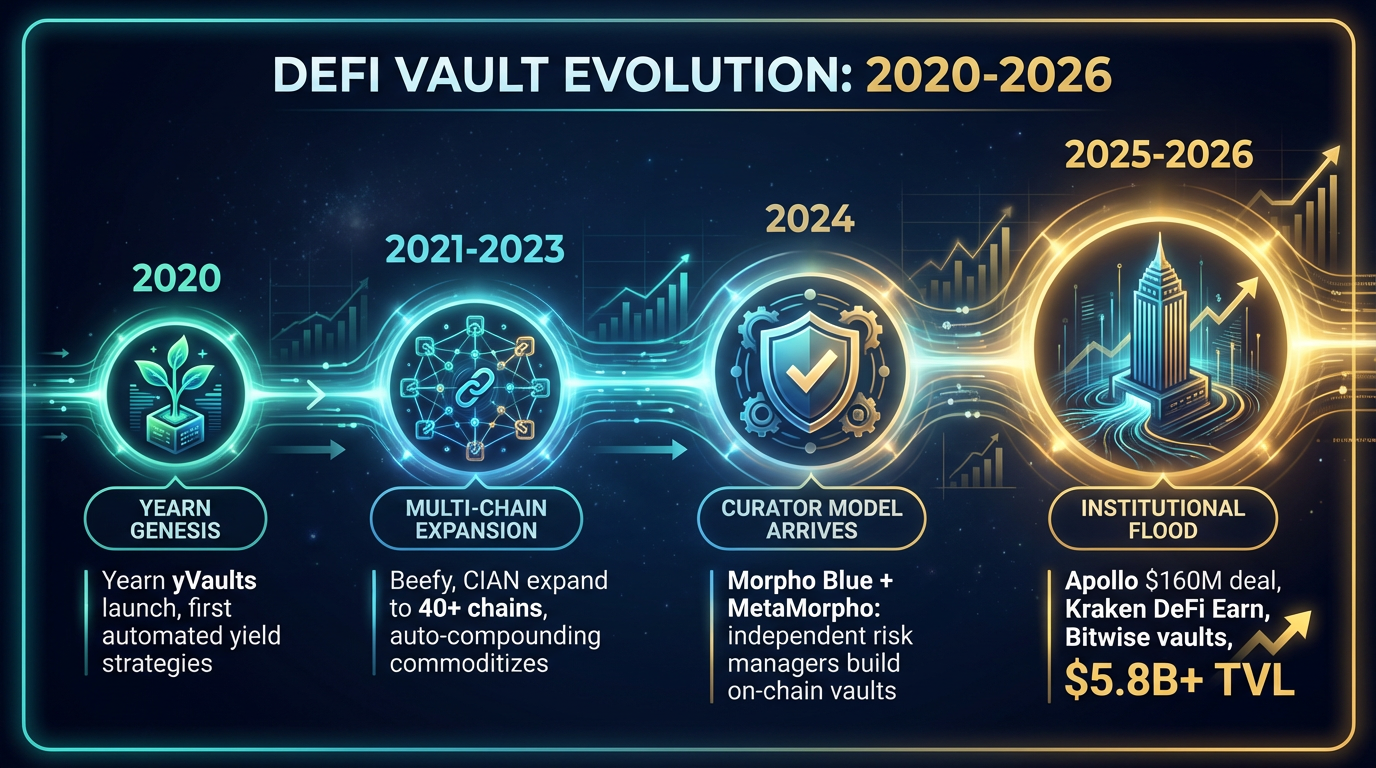
The history of DeFi vaults is shorter than you’d expect, barely five years, but a lot has happened.
2020: The Yearn Genesis. Andre Cronje launched Yearn Finance in July 2020 with a simple concept: deposit stablecoins, and the protocol moves them to whichever lending platform pays the best rate. The “yVaults” that followed automated increasingly complex strategies, like depositing into Curve pools, staking LP tokens for CRV rewards, selling CRV for more stablecoins, and repeating. Yearn’s TVL hit $6 billion at its 2021 peak. It proved that automated yield strategies could attract serious capital.
2021–2023: Multi-chain expansion. Beefy Finance took the Yearn model and ran it across every EVM chain that would have it. By 2023, Beefy supported 40+ chains, auto-compounding hundreds of strategies from BSC to Arbitrum to Avalanche. CIAN, Idle, Harvest, and others carved out niches. The category matured but also commoditized, since auto-compounding a Curve pool on chain X wasn’t fundamentally different from auto-compounding it on chain Y.
2024: The curator model arrives. Morpho Blue launched its permissionless lending primitive, and on top of it, MetaMorpho vaults gave independent risk managers (curators) the ability to build professionally managed lending portfolios. This was new: instead of a protocol’s dev team writing every strategy, external experts could deploy vaults with hard-coded risk parameters enforced by smart contracts. The curator couldn’t steal funds or exceed their own limits. Users picked which curator they trusted, much like choosing a fund manager, except everything was transparent and on-chain.
2025–2026: Institutional flood. Gauntlet, Steakhouse, Block Analitica, Bitwise, and others began managing billions through Morpho vaults. Mellow Finance offered a broader vault engine for restaking and multi-protocol strategies. Veda built enterprise vault infrastructure that powered Kraken’s DeFi Earn launch. And Apollo’s $160 million commitment to Morpho tokens signaled that traditional finance sees curated vaults as legitimate infrastructure, not a niche experiment.
We went from one guy building automated Curve strategies to Apollo buying governance tokens in a DeFi lending protocol. That’s the trajectory.
Two Main Types of Vaults
The vault world today splits into two broad categories. Understanding the distinction helps you pick the right product for your goals.
| Feature | Classic Auto-Compounding Vaults | Curated / Professional Vaults |
|---|---|---|
| How it works | Deposit → protocol runs a fixed strategy → auto-compound rewards | Deposit → independent curator allocates across markets within on-chain rules |
| Who manages strategy | Protocol’s built-in code or community strategists | Independent risk managers (Gauntlet, Steakhouse, Chaos Labs, etc.) |
| Risk controls | Protocol-level audits, community governance | On-chain enforced caps, timelocks, guardians, plus audits |
| Typical assets | LP tokens, single-asset staking, stablecoins | Stablecoins, ETH/LSTs, BTC, sometimes LP positions |
| Complexity | Low (set and forget) | Medium (you choose a curator and vault, but execution is automated) |
| Best for | Retail users wanting simple compounding | Users wanting professional risk management and higher yield potential |
| Examples | Yearn, Beefy, CIAN, Idle | Morpho MetaMorpho, Mellow Core Vaults, Veda/Kraken DeFi Earn |
Classic vaults remain useful. If you want to auto-compound your rewards from a Curve pool on Arbitrum, Beefy is still the easiest path. But for lending-focused yield, stablecoin strategies, and anything involving institutional-grade risk management, curated vaults have become the default.
Deep Dive: Curators, the On-Chain Asset Managers
The curator model is the single biggest innovation in DeFi vaults since Yearn invented the category. It deserves a detailed explanation.
What a curator actually does
A curator is a team, company, or DAO that manages a vault’s strategy and risk parameters. They are not part of the underlying protocol. Gauntlet doesn’t work for Morpho. Steakhouse doesn’t work for Mellow. They’re independent operators, comparable to a fund manager running a portfolio on a brokerage platform.
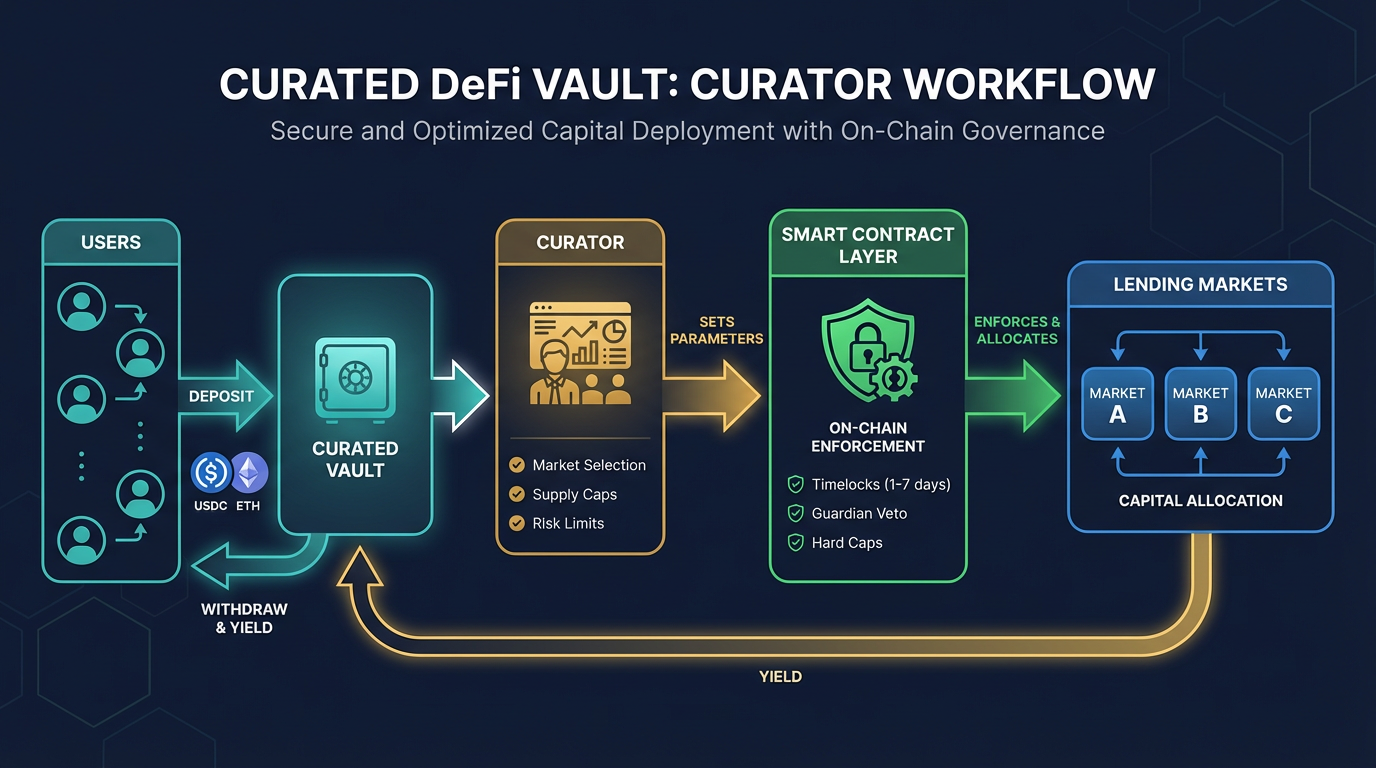
Their job involves three things: selecting which markets or protocols the vault can interact with, setting risk limits (maximum exposure per market, collateral requirements, acceptable oracles), and actively reallocating capital to optimize yield within those limits.
The critical safety architecture
What makes curated vaults different from handing money to a hedge fund is the on-chain enforcement layer. Curators have no custody over deposited funds. They can only adjust parameters, and even those adjustments are constrained.
On Morpho, for example, a curator might manage a USDC vault that lends across several isolated markets. They can whitelist new markets, adjust supply caps per market, and set relative allocation targets. But adding a new market or raising a cap triggers a timelock, typically one to seven days. During that window, any depositor who disagrees with the change can withdraw. There’s also typically a guardian or sentinel address that can emergency-pause or veto changes if something looks wrong.
Mellow’s implementation goes further. Their Core Vaults enforce asset whitelists, per-strategy permissions, oracle validation, and batch accounting at the smart contract level. A curator physically cannot move funds to an unauthorized protocol or exceed defined limits — the contract rejects the transaction.
How curators make money
Most curated vaults charge a performance fee (commonly 5–15% of generated yield) and sometimes a small management fee. Gauntlet’s Morpho vaults, for instance, take a portion of the yield they generate for depositors. This aligns incentives: the curator earns more when the vault performs well.
Top curators in 2026
Gauntlet runs some of the largest Morpho vaults by deposits. They’re a quantitative risk modeling firm that previously managed risk parameters for Aave and Compound. Their USDC and ETH vaults on Morpho have handled billions in deposits.
Steakhouse Financial manages USDC-focused vaults on Morpho, with a reputation for conservative, well-documented strategies. They publish detailed risk reports.
Block Analitica is another major Morpho curator focused on data-driven lending strategies.
Bitwise deployed vaults on Morpho targeting around 6% APY through overcollateralized lending, specifically designed for institutional depositors who want passive yield without touching DeFi directly.
Chaos Labs and Sentora curate the vaults behind Kraken’s DeFi Earn product, using AI-powered risk models to allocate across Aave, Morpho, Sky, and Tydro.
The 2026 Vault Ecosystem: Top Protocols and Products
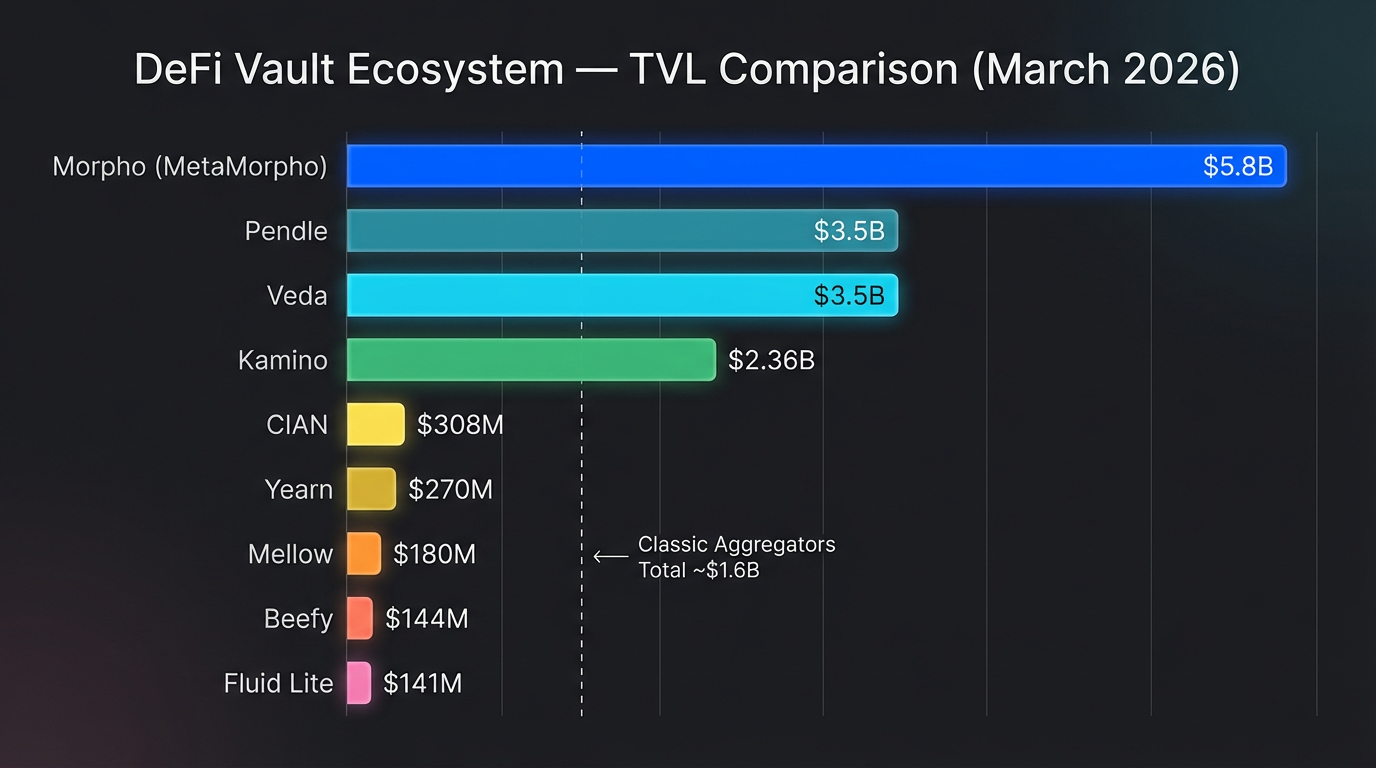
Here’s where things stand in early March 2026, with TVL data sourced from DefiLlama and protocol dashboards.
| Protocol | TVL (March 2026) | Main Chains | Type | Key Strengths |
|---|---|---|---|---|
| Morpho (MetaMorpho) | ~$5.8B | Ethereum, Base + 20 others | Curated lending vaults | Largest vault platform by far, institutional favorite, Apollo partnership |
| Pendle | ~$3.5B | 11 chains (ETH, Arbitrum, BSC, Solana, etc.) | Yield tokenization | Fixed-rate yield, complements other vaults, used inside many strategies |
| Kamino | ~$2.36B | Solana | Liquidity + lending vaults | Dominant on Solana, automated LP and K-Lend, institutional partnerships |
| Veda | $3.5B+ (infra) | Multi-chain | Enterprise vault infrastructure | Powers Kraken DeFi Earn, Krak, and institutional products |
| CIAN Yield Layer | ~$308M | 7 chains | Classic yield aggregator | Largest pure aggregator, advanced automation |
| Yearn Finance | ~$270M | 7 (ETH + L2s) | Classic auto-compounding | The original, still trusted and battle-tested |
| Mellow Finance | ~$180M | Ethereum (mainly) | Permissionless vault infra | Flexible “OS for vaults,” strong Lido integration |
| Beefy | ~$144M | 40+ chains | Multi-chain auto-compounder | Widest chain coverage, simple set-and-forget |
| Fluid Lite | ~$141M | 1 (main) | Single-chain optimizer | Optimized strategies on its primary chain |
Morpho: the clear leader
Morpho is the biggest story in DeFi vaults right now. The protocol’s TVL was above $9.5 billion through H2 2025 and sits around $5.8 billion as of late February 2026 after broader market pullbacks. It remains the second-largest DeFi lending protocol behind Aave.
What sets Morpho apart is its two-layer architecture. The base layer (Morpho Blue) provides permissionless, isolated lending markets. The vault layer (MetaMorpho) lets curators build managed portfolios on top. A problem in one market doesn’t contaminate others, an improvement over monolithic lending pools.
Chain distribution tells its own story: roughly $3.4 billion on Ethereum and $2 billion+ on Base, with smaller deployments on Arbitrum, Hyperliquid, and more. Base growth has been particularly dramatic, surging from $60 million in mid-2024 to nearly $2 billion.
The Apollo deal is worth understanding. Their cooperation agreement lets them acquire up to 90 million MORPHO tokens (9% of supply) over 48 months. Apollo likely intends to leverage Morpho’s modular markets for RWA lending and institutional credit. It’s one of the largest commitments a traditional finance firm has made to any DeFi protocol.
Kamino: Solana’s vault champion
Kamino has become the biggest DeFi protocol on Solana, combining automated concentrated liquidity management with a full lending product (K-Lend). Its TVL peaked above $3.2 billion in Q4 2025 and currently sits around $2.36 billion.
In February 2026, Kamino partnered with Anchorage Digital and Solana Company to let institutions borrow against natively staked SOL without moving assets out of regulated custody. Gauntlet manages around $140 million in strategies across Kamino’s platform, including the CASH vault, a delta-neutral product for minimal price exposure. Kamino also accepted tokenized public equities from Superstate’s Opening Bell platform as collateral, the first time SEC-registered equities have been used directly as DeFi collateral.
Pendle: the yield infrastructure layer
Pendle doesn’t operate vaults in the traditional sense, but it powers many of them. Its yield tokenization protocol splits yield-bearing assets into principal tokens (PT) and yield tokens (YT), letting users lock in fixed rates or speculate on variable yield.
At $3.5 billion TVL across 11 chains, Pendle has become foundational infrastructure. Many Morpho and Kamino strategies include Pendle positions internally. Want a fixed 5% on your stETH for six months rather than a floating rate? Pendle’s market is where that trade happens.
The classic aggregators
Yearn, Beefy, and CIAN still serve important roles, especially for users who want simple auto-compounding without choosing a curator. Yearn recently implemented a revenue-sharing model where 90% of protocol revenue goes to stYFI stakers. Beefy’s 40+ chain coverage makes it the default for anyone farming on smaller or newer networks. CIAN leads the pure aggregator category at ~$308 million.
But the TVL gap is telling. The entire yield aggregator category on DefiLlama is around $1.6 billion. Morpho alone is 3.5x that. Capital, particularly institutional capital, has migrated to the curated model.
Real-World Use Cases and Strategies
Stablecoin yield
The most popular vault category in 2026. A typical approach: deposit USDC into a Morpho vault curated by Gauntlet or Steakhouse. The curator allocates across lending markets where borrowers post ETH, BTC, or LSTs as collateral. APYs fluctuate with borrowing demand but generally range from 3–8% for conservative stablecoin vaults. Kraken DeFi Earn does essentially the same thing with an exchange wrapper, advertising up to 8% APY through Veda-powered vaults.
ETH and LST strategies
Depositors looking for yield on their ETH often use vaults that lend wstETH or leverage staking positions. Mellow’s Lido stRATEGY vault is a flagship example, holding around $70 million and allocating ETH/wstETH across Aave, Spark, Ethena, and Fluid with a 7-day average APY around 3.7%. Morpho also has large ETH vaults where curators lend against various collateral types.
BTC exposure
Bitcoin yield was historically hard to find in DeFi, but 2025–2026 changed that. Mellow runs BTC vaults using tBTC and cbBTC as base assets, some with promotional APYs above 5%. Kamino integrated FBTC (Function’s 1:1 Bitcoin-backed asset on Solana) as collateral, giving BTC holders access to over $500 million in stablecoin liquidity. Morpho has cbBTC pools on Base with significant activity, recently holding over $1.7 billion in a single cbBTC market.
Restaking plays
Mellow’s integration with the Lido Alliance and Symbiotic makes it a natural home for restaking strategies. Their Decentralized Validator Vault (~$33 million TVL) routes wstETH through Lido’s Simple DVT module plus incentives, earning around 3.8% while helping decentralize Lido’s validator set.
Retail vs. institutional
A retail user with $10,000 in USDC might start with Kraken DeFi Earn (zero wallet setup) or deposit directly into a Morpho vault through app.morpho.org (requires a wallet like MetaMask). An institution deploying $50 million probably uses a Bitwise or Gauntlet-managed vault on Morpho, appreciating the audited risk rails and the ability to verify every allocation on-chain. The infrastructure is the same, but the entry points differ.
Risks, Mitigations, and Best Practices
Vaults are safer than raw yield farming, but they aren’t risk-free. Here’s what can go wrong and how the ecosystem addresses it.
| Risk | What It Means | Mitigation |
|---|---|---|
| Smart contract risk | A bug in the vault or underlying protocol could be exploited | Multiple audits, immutable/non-upgradeable contracts (Morpho Blue is 650 lines), ERC-4626 standard reduces surface area |
| Curator risk | The risk manager makes a poor allocation decision | On-chain caps, timelocks on changes (1–7 days), guardian vetoes, reputation systems |
| Market/liquidation risk | Collateral in a lending market drops in value, causing bad debt | Isolated markets (Morpho) prevent contagion, conservative LTV ratios, oracle redundancy |
| Oracle risk | A price feed gives incorrect data, leading to improper liquidations or bad debt | Multi-oracle setups, Chainlink integration (Kamino), protocol-level price validation |
| Liquidity risk | You can’t withdraw because too much capital is lent out | Most vaults maintain liquidity buffers, Kraken warns of possible withdrawal delays |
| Regulatory risk | Legal changes could affect protocol operations or token value | Non-custodial architecture limits exposure, US-based products (Kraken) already comply with local regulations |
How to evaluate a vault before depositing
Before putting money into any vault, check these things. Look at the curator’s track record, specifically how they handled stress events. Review the vault’s on-chain parameters: what markets are whitelisted, what are the supply caps, what’s the timelock duration? Check whether the smart contracts have been audited and by whom. Compare current APY against historical performance. And verify you’re on the correct URL — phishing sites are a real threat.
If you can’t find clear documentation about how a vault works, who manages it, and what the fees are, don’t deposit.
Step-by-Step: How to Start Using Vaults Today
For DeFi-native users (you have a wallet)
- Go to app.morpho.org and connect your wallet. Navigate to the “Vaults” tab.
- Browse available vaults. Filter by asset (USDC, ETH, WBTC), chain (Ethereum, Base), or curator.
- Review the vault details. Check the curator, current APY, TVL, underlying markets, supply caps, and timelock duration.
- Deposit. Approve the token, enter your amount, confirm. You receive vault shares (ERC-4626 tokens) representing your position.
- Monitor or forget. Your position compounds automatically.
- Withdraw anytime by redeeming your shares for the underlying asset, subject to available liquidity.
For Solana users, the process is similar on app.kamino.finance. For Mellow, visit app.mellow.finance/vaults.
The Future of DeFi Vaults in 2026 and Beyond
Several trends are worth watching.
Institutional scale is just beginning
Apollo’s deal with Morpho is the first of its kind at this scale, but it won’t be the last. Bitwise has already deployed vaults targeting institutional depositors. Kraken brought vault-based yield to millions of exchange users. As regulatory clarity improves around stablecoin frameworks in the US and EU, expect more traditional asset managers to build on vault infrastructure.
RWA integration
Kamino’s acceptance of tokenized equities as collateral opened a door. If tokenized treasuries, bonds, and equity can serve as collateral in DeFi lending markets, vaults become the natural interface for managing those positions. Apollo’s involvement with Morpho likely points in exactly this direction — building on-chain credit markets backed by real-world assets.
AI-assisted curation
Chaos Labs already describes its risk models as “AI-powered.” As on-chain data becomes richer, expect curators to automate more of the allocation process. Risk parameters might still be set by humans, but rebalancing, rate optimization, and anomaly detection can increasingly be handled by machine learning. This doesn’t eliminate curator risk — it shifts it from human judgment errors to model errors, a different set of tradeoffs.
Cross-chain expansion
Morpho’s growth on Base shows that vaults follow capital. As new chains attract liquidity (Hyperliquid, Monad, and others are growing), vault protocols will deploy there. Veda’s multi-chain infrastructure supports this pattern: one integration lets an app offer vaults across multiple networks.
Morpho V2
After over a year in development, Morpho V2 is expected to launch in 2026 with a major change: shifting from protocol-dictated interest rate formulas to market-driven rates where participants set rates organically. This mirrors how traditional credit markets work and could accelerate institutional comfort with on-chain lending.
Conclusion
DeFi vaults in 2026 are not the experimental, degen-only products they were a few years ago. Curated risk management, on-chain enforcement, and institutional adoption have turned them into a real yield-generating layer for any crypto holder.
